
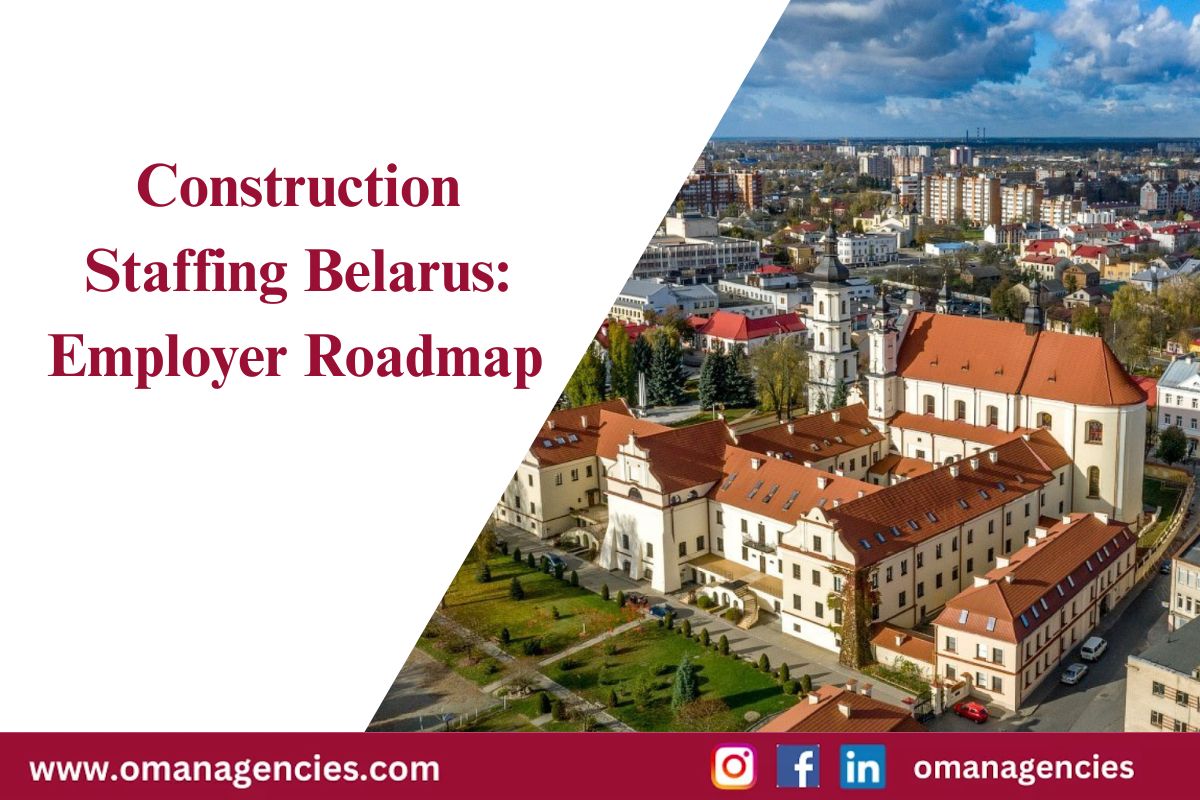
Construction Staffing Belarus: Employer Roadmap
Belarus Construction Growth: Staffing Strategies Amid Shortages
Belarus is currently undertaking a significant infrastructure development project, including the construction of roads, housing, industrial sites, and logistics hubs.
Recent updates from the authorities indicate that the number of long-stalled projects has dropped sharply, nearly 93%, meaning more sites are finally moving forward again and new ones are emerging behind them.
If you run a construction or engineering company, this sounds like good news. Yet, on the ground, there is another reality that site managers face every day: projects are ready, but finding the right people is challenging.
In this article, we will look at why staffing is such a challenge in Belarus, how smart recruitment strategies can help, and where a specialist partner like Oman Agencies fits into the picture.
Belarus’ construction is busy, but skilled workers are missing
Across Europe and Eurasia, construction employers are facing ongoing skill shortages in trades and technical roles. Various international labour reports talk about gaps in the supply of qualified workers for infrastructure, housing, and public works.
In Belarus, contractors often find that:
- Local tradespeople are already committed to long-term projects.
- Younger workers are more interested in IT or services than in site work.
- Deadlines are becoming increasingly tight as stalled projects are restarted and new ones are approved.
The result is familiar: schedules slip, overtime costs rise, and your core team is under constant pressure.
So how do you keep your sites staffed without burning out the people you already have?
Why local hiring alone is not enough
Relying solely on local job boards or word of mouth can be effective for small jobs. It becomes risky when you:
- Win a large civil or industrial project with fixed completion dates.
- Need specific skills, for example, certified welders, crane operators, or finishing specialists.
- Run several sites in parallel across different regions.
At that point, the local talent pool simply is not deep enough. You need a way to combine:
- Local Belarus workers who know the language, regulations, and culture.
- Skilled international workers from labour-rich countries who can be mobilised quickly and legally.
Balancing these two sources is where a specialist construction staffing partner is valuable.
How a construction staffing partner like Oman Agencies helps
Oman Agencies is an international manpower consultancy that has been supplying workers for construction and infrastructure projects worldwide for over 50 years.
For Belarus construction employers, a partner like this can:
- Map your manpower needs by project phase – groundwork, structure, MEP, finishing.
- Source trades and engineers from Asia, Africa, and Europe through established recruitment networks.
- Screen candidates for skills, safety awareness, and basic language fit before you even interview them.
- Handle documentation and mobilisation, saving your HR team a lot of administrative work.
You move from reactive hiring to a planned manpower pipeline.
A simple staffing plan for Belarus projects
Let us put this into a concrete flow that a Belarus contractor can follow.
1. Start staffing at the tender stage
When you bid for a project, share basic information with your recruitment partner:
- Location and type of project
- Estimated start date and duration
- Roles and headcount by phase
This allows them to start building a talent pool early, not at the last minute.
2. Decide the mix of local and international workers
Some roles may be entirely local, for example, site administrators or certain supervisory positions. Highly specialised or high-volume trades can be filled with overseas workers who have already built similar roads, plants, or complexes abroad.
Together with your partner, you can decide:
- Which positions are local only
- Where international talent is essential
- What language or certification is required for each group
3. Standardise trade tests and interviews
Ask your agency to use the same trade tests for each role, for example, rebar fixing, concrete finishing, or scaffolding erection. This maintains quality consistency and facilitates easier comparison of candidates.
You can then run final interviews online, focusing on safety mindset and communication.
4. Plan mobilisation and onboarding
Once offers are accepted, your recruitment partner will coordinate visas and travel arrangements. You prepare:
- Site accommodation and welfare
- Safety inductions in the local language
- Clear reporting lines for each crew
This preparation significantly enhances retention within the first 90 days.
Quick checklist for Belarus construction employers
Before you open the next project, ask yourself:
- Do we know our manpower needs by month, not just total headcount?
- Do we have a trusted construction recruitment partner, or do we start from scratch every time?
- Are we using both local and international workers where it makes sense?
- Do we have a simple onboarding process that new workers can understand in one day?
If several answers feel uncertain, it may be the right moment to rethink your staffing strategy.
FAQs: Construction staffing in Belarus
- Can foreign workers be used legally on Belarus construction projects?
Yes, but only within the country’s labour and migration rules. A reputable international manpower agency will work within these regulations and guide you on the required permits and documentation based on the project and the nationality of workers. For broader labour trends, you can refer to reports from organisations such as the International Labour Organization. - What kinds of roles can Oman Agencies help fill for Belarus projects?
Oman Agencies supplies a wide range of construction roles, including civil and mechanical engineers, supervisors, crane operators, carpenters, masons, electricians, and other project staff, as outlined on their construction and infrastructure recruitment pages. - How long does it usually take to mobilise international workers?
Timelines vary, but if planning starts at the tender or early award stage, many clients can have vetted workers on site in line with their project schedule. The key is to share realistic timelines and documentation requirements with your recruitment partner so they can synchronise sourcing and mobilisation.
